Ecosystem
Structure, clarity, and orientation form the shared foundation across Continuum One products. This page explains the principle behind them.
One ecosystem, one principle
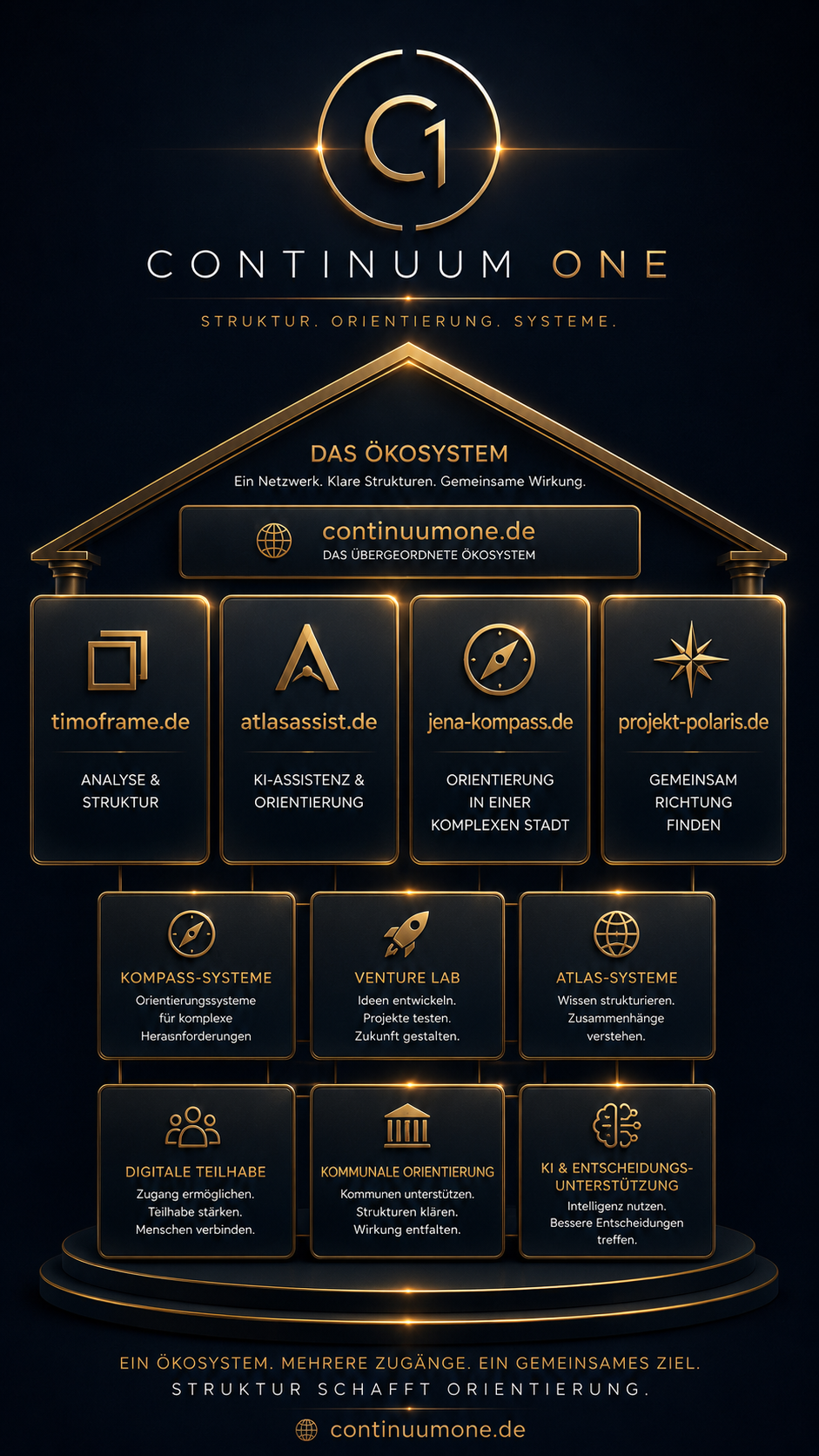
Continuum One products are not built in isolation. They share a common approach to structure, clarity, and orientation, and connect where that creates real value for users.
Fields of structure
Complexity appears wherever information exists without a usable structure. Those are the environments we work in.
Public sector and municipalities
Processes, responsibilities, and documents exist, but they are rarely organized from the perspective of the people who need them.
Organizations
Growing structures create knowledge that becomes difficult to find. Orientation becomes the bottleneck.
People making decisions
People cannot take a useful next step if they do not understand where they are. That is where our systems begin.
Technology and data
Structured data instead of guessed answers: facts provide the foundation, while AI explains and connects them.
Rules and regulation
Rules can be robust yet hard to navigate. We translate them into understandable paths.
Product and structure
Reusable components for different fields without artificially mixing unrelated products.
From structure to impact
Structure and AI are not ends in themselves. They are the foundation for turning organized information into usable systems and real-world application.
Structure
Information, situations, and relationships are organized into a traceable model.
Intelligence
AI understands, explains, connects, and supports on top of a reliable data foundation.
Action
Information becomes a concrete next step that can actually be taken.
Real-world application
Technology creates value in everyday life, organizations, municipalities, and eventually physical systems.
The Compass model
People think in problems, situations, and goals, not in data models or administrative procedures. Our systems therefore follow the same sequence of four questions.
The Compass model is the methodological logic behind applications across the ecosystem. It reduces complexity without distorting the underlying information.
Where am I?
The situation is captured and described in understandable terms.
What does this mean?
Rules, responsibilities, and requirements are placed in context.
What can I do?
Possible paths become visible together with their conditions.
What is my next step?
A concrete, achievable action instead of an information overload.
Where this leads
The shared principle becomes concrete products and applications where the systems have to work in practice.